
Three Calls You'll Get After the First Storm, and the Six Things That Caused Them

Sacramento goes five or six months without real rain. Then one storm arrives in October or November and undoes everything the dry season was hiding.
The Monday after that first storm is one of the busiest call days of our year. Almost none of it is an actual emergency. It's deferred maintenance that had a 60-day window nobody used.
The cost gap is the whole argument for using that window. A clogged downspout dumping against a foundation runs about $200 to clear and re-route in October. Leave it, and after a winter of that water going where it shouldn't, you're looking at roughly $8,000 in drywall, flooring, and mitigation. Same building, same failure, different month.
Here are the three calls we get most often after a first storm, what's actually behind each one, and what to look at now.
Call 1: "There's a stain on my ceiling."

This one usually comes in a few days after the rain stops, which is exactly what makes it expensive. Water that got in during the storm has already traveled. By the time it shows on a ceiling, it has run down a rafter, soaked insulation, and sat in a wall cavity for 48 hours. You're no longer fixing a leak, you're fixing a leak plus everything the leak touched.
Two entry points cause most of these.
Roof penetrations. Not the roof field, the holes in it. Plumbing vents, furnace flues, swamp cooler curbs, satellite mounts, skylight flashing. A Sacramento summer cooks the sealant around those penetrations until it cracks, and the crack doesn't matter until the first time water is sitting on it. On older roofs we also see flashing that was face-nailed and never sealed.
What to look at: the rubber boots on plumbing vents, which split in a ring around the pipe. Sealant at any curb or equipment mount. Flashing where the roof meets a wall or a chimney.
Gutters and downspouts. A gutter full of summer debris doesn't drain, it overflows, and overflow goes behind the fascia and down the wall. Downspouts are the sneakier half, because they look fine from the ground. The failure is at the bottom: an extension that came off, an underground drain packed with roots, a splash block a landscaper kicked aside in June.
What to look at: clear the gutters, then follow every downspout all the way to where it discharges. If you can't see where the water ends up, that's the one to fix first.
Call 2: "Water came in under the slider."
This one arrives during the storm, usually from the tenant, usually with a photo. It's the call most likely to escalate, because there's standing water in a living space and somebody is putting towels down at 10pm.
It almost never has a single cause. It's two failures stacking.
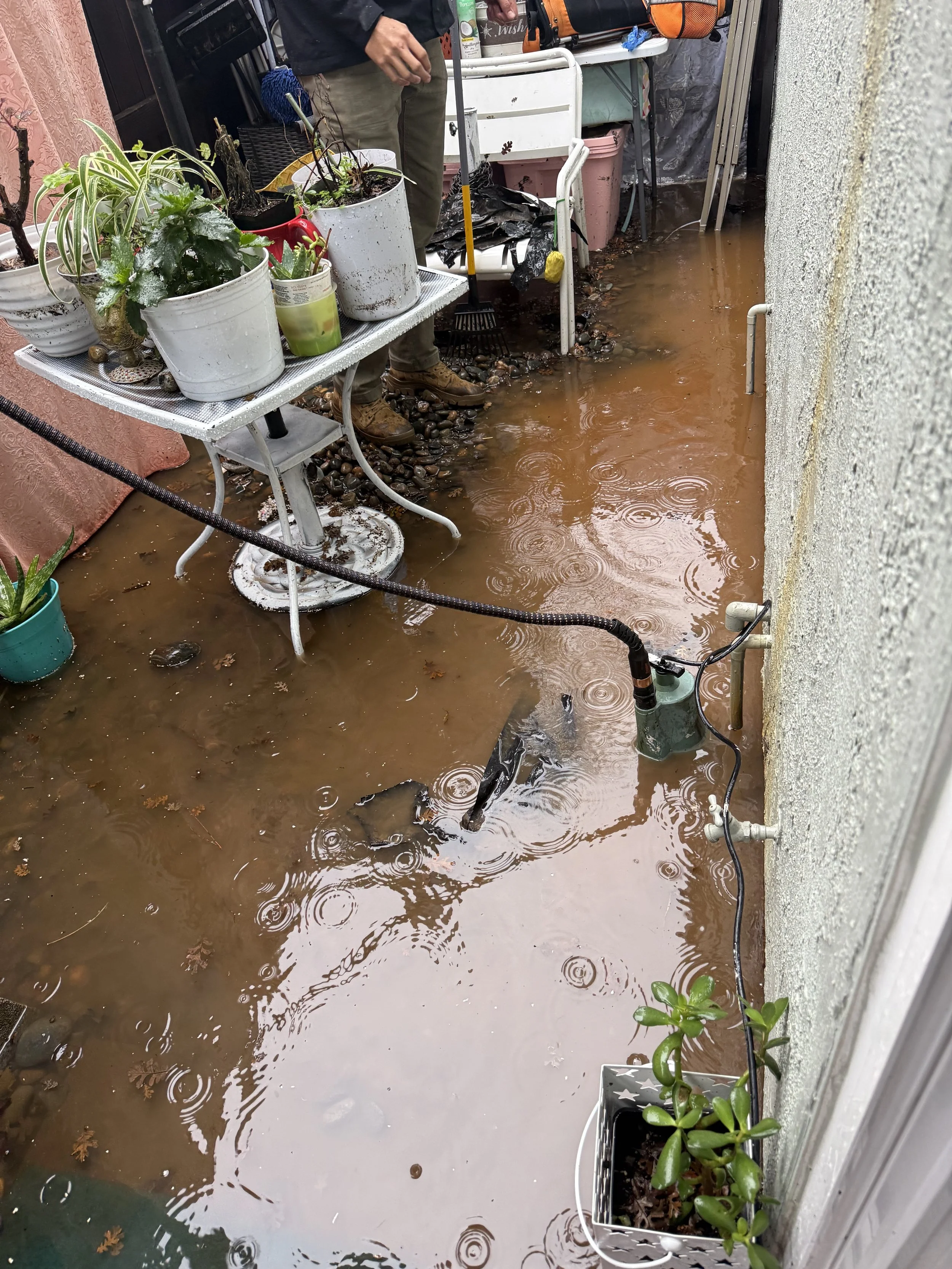
Grading and pooling. Water needs somewhere to go, and on a lot of Sacramento rentals it has nowhere. Soil built up over the years until it slopes back toward the building. Planter beds sitting above the slab line. A patio or AC pad poured flat with no fall away from the structure. None of that matters in July. In a storm it means the water at that threshold is now higher than the threshold.
Window and door seals. Glazing that's dried and pulled away from the frame, weatherstripping compressed flat, caulk at a slider track that cracked two summers ago. On its own, a tired seal usually holds, because nothing is pushing water at it. Put that same tired seal three inches from a puddle and you have an interior leak.
This is why fixing one without the other doesn't hold. New weatherstripping on a door that's sitting in standing water buys you one season at most. Drainage first, seal second.
What to look at: walk the building during or right after a rain and note where water stands. Then check the seals only at those spots. It's a much shorter list than checking every opening on the property.
Call 3: "The unit smells musty."
This is the slow one. It doesn't come the Monday after the storm, it comes three or four weeks later, and it's the one most likely to turn into something bigger than a repair ticket. A tenant reporting a persistent musty smell is describing moisture that's been sitting somewhere for a while. Where that conversation goes is a question for your attorney and your carrier, not for us. You'd rather not have it at all.
Crawlspace vents. Vents get blocked by landscaping, lose their screens, or sit below the surrounding grade and take on standing water. A crawlspace that can't dry out puts moisture into the floor system continuously, and the first sign is almost always smell rather than a visible leak.
What to look at: every vent should be open, screened, and above the dirt line. If a vent is buried or a bush has grown over it, that's a 20-minute fix with real downstream value.
Failed exterior caulking. Cheapest item on this list and the one that gets skipped the most. Siding transitions, trim joints, hose bibs, and the penetrations for electrical, gas, and cable. Each gap is small on its own. Together they let a meaningful amount of water into a wall assembly during a driving rain, and wall assemblies dry slowly.
What to look at: the sunny and weather-facing elevations first. That's where the caulk fails soonest, and on most Sacramento properties it's the south and west walls.
The six, in one list
Roof penetrations: boots, flashing, curbs, and mounts
Gutters and downspouts: clear the top, follow the bottom
Grading and pooling: does water run away from the building or toward it
Window and door seals: check the openings where water actually stands
Crawlspace vents: open, screened, above grade
Exterior caulking: siding transitions, trim, hose bibs, utility penetrations
What this looks like in October
On a typical fourplex, walking all six takes us under an hour. Most of what we find is in the $150 to $600 range to correct, and we do the correction the same day we're out there rather than writing it up for later.
I own rentals myself, so I'll say the quiet part: the reason this gets deferred isn't that PMs don't know about it. It's that in September, when it's 98 degrees and the property is dry, nothing about a gutter feels urgent. The window to fix this cheaply is the exact window when it's hardest to care about.
QuickTurn Maintenance is a licensed contractor (License #1152617) serving property managers throughout Sacramento and the surrounding region. We're running pre-storm gutter and drainage walkthroughs at a flat rate through October. If you want your portfolio walked before the first real rain, book before November 1 and we'll get it on the calendar.
