
The Fair Housing Compliance Checklist Every California Property Manager Should Have
Fair housing compliance isn't a one-time task. It's an ongoing operation. Use this checklist to audit your current practices, train your team, and make sure nothing falls through the cracks.

Compliance Starts With a System
The most common fair housing violations in California aren't the result of bad intentions. They're the result of inconsistent systems, places where one tenant gets a different experience than another, and no one ever notices.
The good news is that consistent systems are also the easiest to document, defend, and scale. If you ever face a complaint, your paper trail is your best protection. If you never face one, your systems are why.
This checklist covers every stage of property management where fair housing risk lives. Review it with your team at onboarding and at least once a year.
Your Fair Housing Compliance Checklist
Section 1: Tenant Screening and Leasing
☐ Written screening criteria are documented and applied equally to every applicant
☐ Screening standards are based solely on objective factors: income, credit history, and rental history
☐ No questions about protected characteristics are asked during the application or screening process
☐ All applicants receive accurate, consistent information about unit availability
☐ Rental rates, deposits, and lease terms are the same for all applicants for comparable units
☐ Advertising language is reviewed for neutral phrasing with no preferences stated or implied
☐ Screening decisions are documented with the reason for approval or denial
Why it matters: Inconsistent screening is the most common source of fair housing complaints. Documented, standardized criteria are your first line of defense.
Section 2: Maintenance and Repairs
☐ Every work order is logged with the date and time of submission
☐ Every work order is logged with the date and time of completion
☐ Written priority tiers are established (emergency, urgent, routine) and applied consistently
☐ Response time standards are the same across all units in your portfolio
☐ Disability-related repair requests are flagged and handled promptly
☐ Reasonable modification requests are responded to in writing
☐ Vendor performance is monitored for scheduling patterns or quality inconsistencies across units
☐ All vendors are briefed on fair housing standards before working on your properties
Why it matters: Unequal maintenance response times are one of the most overlooked fair housing risks. Patterns in who gets fast service and who waits can support a discrimination complaint even without any intent.
Section 3: Disability Accommodations
☐ A written process exists for receiving and evaluating reasonable accommodation requests
☐ All accommodation requests are acknowledged in writing promptly after receipt
☐ Requests are evaluated on a case-by-case basis with no blanket approvals or denials
☐ Responses to accommodation requests are issued in writing with a clear decision and rationale
☐ Tenants are allowed to make reasonable modifications at their own expense when needed for equal access
☐ Restoration requirements (if any) are clearly communicated in writing at the time of approval
☐ Staff are trained to recognize what an accommodation request looks like, including informal verbal requests
Why it matters: Ignoring or delaying a reasonable accommodation request is treated the same as denying it. A written process protects the tenant and protects you.
Section 4: Tenant Relations and Ongoing Management
☐ Lease rules and community policies are enforced consistently across all tenants
☐ Entry notice procedures are followed for every unit with the same format, same lead time, every time
☐ No adverse action is taken against a tenant within 180 days of a repair complaint or fair housing activity without documented independent justification
☐ Amenities, services, and common areas are equally accessible to all tenants
☐ Tenant communications are professional, consistent, and documented
Why it matters: Fair housing protection continues throughout the tenancy. Selective enforcement of rules or retaliation for complaints are among the most litigated fair housing issues in California.
Section 5: Staff and Vendor Training
☐ All staff complete fair housing training at onboarding
☐ Annual fair housing training is scheduled and documented
☐ Maintenance technicians are trained on disability accommodation basics and consistent service delivery
☐ Vendors are vetted for fair housing awareness before being added to your approved list
☐ Staff know how to recognize and escalate a potential fair housing issue
☐ Staff understand that retaliation against tenants who complain is illegal
Why it matters: Your liability doesn't stop with your direct employees. Vendors and contractors working on your properties are an extension of your operation. Their conduct is your responsibility.
Section 6: Documentation and Administration
☐ All screening decisions are documented with a clear, objective rationale
☐ Reasonable accommodation requests and responses are kept on file
☐ Work order records are retained and reviewable
☐ Tenant communications related to complaints or disputes are documented
☐ Policies are reviewed annually for changes to California fair housing law
☐ Legal counsel is consulted for complex accommodation requests or when a complaint is filed
Why it matters: Documentation is your defense. In a fair housing investigation, the burden often shifts to you to show that your decisions were consistent, objective, and lawful. Good records make that possible.
A Quick Reference: California's Protected Classes
Under federal and California law combined, you cannot discriminate based on:
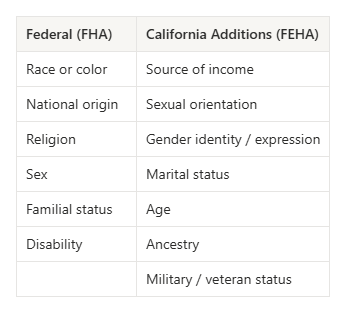
California's list is among the longest in the country. If you're operating under federal standards only, you're likely out of compliance with state law.
What to Do If a Complaint Is Filed
Even with a perfect system, complaints can happen. Here's the short version of what to expect:
HUD or the California Civil Rights Department notifies you of the complaint
You have the opportunity to respond in writing
An investigation begins. HUD has 100 days to complete it
You'll be offered the chance to resolve it through a Conciliation Agreement
If not resolved, the case proceeds to an Administrative Law Judge or federal court
The most important thing you can do right now is build the documentation habits that make step 2 easy. A clear paper trail of consistent, equal treatment is the most effective defense available.
How QuickTurn Maintenance Supports Your Compliance
Consistent maintenance operations are one of the most important and most overlooked pieces of fair housing compliance. At QuickTurn Maintenance, every work order is documented, every response is consistent, and every technician understands that equal service delivery isn't optional.
We work with property managers across the Sacramento region who want a maintenance partner they can trust to protect their portfolio rather than create liability for it.
Ready to tighten up your maintenance compliance? Contact QuickTurn Maintenance today.
This checklist is for general informational and training purposes. It does not constitute legal advice. Fair housing laws are subject to change. Consult a qualified attorney for guidance specific to your situation. For California fair housing resources, visit calcivilrights.ca.gov or contact HUD's San Francisco Regional Office at 1-800-347-3739.
